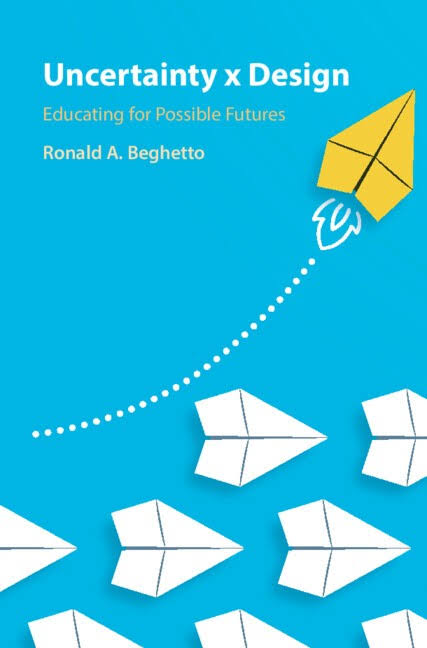
What do we owe students? The book argues that they need opportunities to shape possible futures through what they do now. Uncertainty x Design (UxD) begins with meaningful problems whose solutions are still unknown. With guidance, students develop actionable possibilities and learn to act on them. The aim is to make a positive contribution to others.
Education promises to prepare students for the future, yet much of that future cannot be known in advance. The book asks what learning experiences could help young people influence possible futures through their actions today.
01Rethink readinessThe future is still being made.
AI-generated thematic illustration.
Education promises to prepare students for the future, yet much of that future cannot be known in advance. The book asks what learning experiences could help young people influence possible futures through their actions today.
From preparing for likely futures to shaping possible ones
Backward design starts with what students should know and works back to the learning experience. The book recognizes its value for developing established knowledge and skills. But when predetermined answers dominate, students may have fewer opportunities to explore questions that nobody has already settled. A story about a child attending a seemingly different school illustrates how familiar its underlying expectations can remain.
What might change if preparing students for the future also involved helping them create it? This would require opportunities to use what they know in situations where the outcome remains open.
UxD begins with known-unknowns. These are problems students recognize but do not yet know how to address. Teachers help them engage with these problems in a structured, supportive environment. Leaving parts of the work open gives students meaningful decisions to make.
Give students room to decide, with support to proceed
Teachers can leave parts of a lesson for students to decide. Students might determine the task or how to approach it. They can also help develop the outcome and aspects of the success criteria as the work proceeds. Hybrid lessons offer a gradual way to introduce these choices. Fuller UxD projects let students identify problems they care about and help determine how to address them.
Teachers still provide guidance and access to relevant expertise. Students may also recognize problems adults have missed. The aim is to create enough uncertainty to invite creative action, with support that helps students engage productively.
Chapters 3–5, especially pp. 43–48, 64–66, 77–88.
03Develop possibilitiesExplore before committing.
AI-generated thematic illustration.
An uncertain problem invites students to explore different ways forward. An actionable possibility must depart from what already exists and be feasible to put into action. Evaluating an idea can also help students see new possibilities.
Which possibilities are worth pursuing?
Students can make the familiar unfamiliar by questioning an assumption, or make the unfamiliar familiar through analogy. “What if” thinking opens a possibility. “As if” thinking helps explore how it might work. Students then seek focused feedback on promising ideas. After students have developed several possibilities, the book suggests strategies for selecting those that seem most actionable.
One option is the top-two approach, which involves choosing two possibilities to explore further. Students may combine these possibilities or return to ones they set aside. They can also generate new possibilities. Pre-testing includes imagining why a proposal could fail and refining it before implementation.
For complex UxD projects, this can help students notice problems they might otherwise overlook in an exciting idea. The process remains iterative. Evaluating an idea can lead students back to generating new possibilities.
Chapter 6, especially pp. 96–108.
04Support creative actionWhat might help students act on an idea?
AI-generated thematic illustration.
A promising possibility still needs someone willing to pursue it. The book examines students’ confidence and the value they see in acting. It also considers their willingness to take creative risks and the social support available to them.
What beliefs shape the decision to act?
Agentic beliefs are students’ judgments about whether they can act and why doing so matters. They also include willingness to take the risks involved. A student may see an idea’s value yet doubt their ability to carry it out. Another may feel capable but judge the risks too high. The book’s threshold model suggests that social support can expand the uncertainty students feel able to address.
A project may still need to be narrowed. Too much adult direction can also leave students with few decisions of their own. Teachers can check these beliefs before engagement and during the work. Reflection afterward can help students understand setbacks and manage their responses. Deciding whether to persist or change direction remains a judgment made with support.
Chapter 7, especially pp. 115–130; check-in tools, pp. 131–137.
05Make principled contributionsHow might the work affect others?
AI-generated thematic illustration.
UxD asks students to consider how their learning might contribute beyond their own achievement. They put what they learn to creative use and examine whether their work benefits others. This requires continuing attention to the people affected.
Consider benefits and possible harm
The cone of contributions helps students consider who their work might benefit, beginning with themselves and people close to them. It extends to the broader community, including people they may never meet and future generations. Alongside imagining benefits, students can use “what if-not” thinking. What if an idea fails to help or causes harm?
“If not-then” thinking helps them prepare a response. In the book’s hypothetical playground renovation, students investigate local needs and plan for continued maintenance. They keep checking whether the work serves its intended community. An unsuccessful project may still contribute through shared learning, while leaving the team responsible for its effects.
The closing section, titled Avanti, invites educators to adapt and test UxD in their own contexts.
Chapter 8, especially pp. 138–150, 152–155; Avanti, pp. 160–161.
02 / Connecting ideas
What carries through.
Give students opportunities to contribute now
The opening question asks what education owes young people. The conclusion returns to this responsibility by calling for opportunities for students to shape their lives now. Learning to contribute can be part of their education, beginning well before adulthood. (Chapter 1; Avanti.)
Knowledge and unknowing work together
What students already know can help them make sense of unfamiliar problems. Teacher expertise remains valuable, while students bring knowledge that teachers may lack. Questions neither can fully answer in advance can open opportunities to learn together. (Chapters 3–5; pp. 140–142.)
Keep possibilities open to revision
Students evaluate the possibilities they generate and seek feedback. Trying an idea can then reveal a need to refine it or return to another possibility. These experiences help inform the decision to persist with an approach or pivot to a different one. (Chapter 6; pp. 120, 141–142.)
Support continues as the work develops
Early in the book, support helps students engage with uncertainty. Later it helps them take action and respond to setbacks. In the final chapter, teachers and community partners also help students examine whose lives their work affects. (Chapters 3, 7–8.)
03 / The conclusion
Students help author what comes next.
What can educators do now? The book suggests opening parts of existing learning experiences to student decisions and adapting UxD’s tools with them. Researchers are invited to study UxD’s effects and work alongside educators and students to develop new designs. These efforts can help students learn to contribute through creative action.
They also provide opportunities to revise their work as its consequences become clearer. (Avanti, pp. 160–161.)
If you remember only this
Preparing students for possible futures includes giving them meaningful opportunities to help create those futures now.
An interpretive reading
One way to read the book is as an invitation to expand what it means to prepare students for the future. Structured uncertainty gives them room to make decisions and act on what they learn. Principled contribution directs attention to how those actions affect others. This five-movement map brings together the book’s eight chapters to help readers follow the argument.
UxD projects can unfold in different ways.
04 / Questions to carry forward
What needs further consideration?
Questions for interpretation and further inquiry.
How much uncertainty is productive here?
The uncertainty students feel able to act on can change with their situation. The book’s threshold model offers a way to consider how support might help, while leaving the appropriate level of challenge to judgment. When does guidance help students make their own decisions? When might it begin to take over? (Chapters 4–5; pp. 116–120.)
Which outcomes need further investigation?
Research and examples inform the proposed approach, while leaving questions about its outcomes in different settings. The closing section calls for further study of whether UxD supports students and under what conditions. The book also acknowledges that UxD can be less efficient for rehearsing established knowledge. (pp. 47–48, 160–161.)
Who decides whether a contribution helps?
The book treats checking a project’s effects as a shared responsibility. How will the people affected help determine whether the work benefits them? This becomes especially important when they disagree with the project team. The book’s emphasis on feedback and preparing for possible problems offers ways to begin addressing these questions. (pp. 145, 149–155.)